How we replaced a spreadsheet-per-grant habit with a three-tier Smartsheet portfolio — standardized intake, blueprint provisioning, and executive rollups that assemble themselves.
A grantmaking nonprofit was scaling its portfolio faster than its tracking could keep up. Each awarded grant lived in its own ad hoc spreadsheet, built by whoever managed that program, structured however made sense at the time.
The design decision that drives everything downstream is the reporting hierarchy. Get it right before building anything, because every dashboard, rollup, and automation inherits from it.
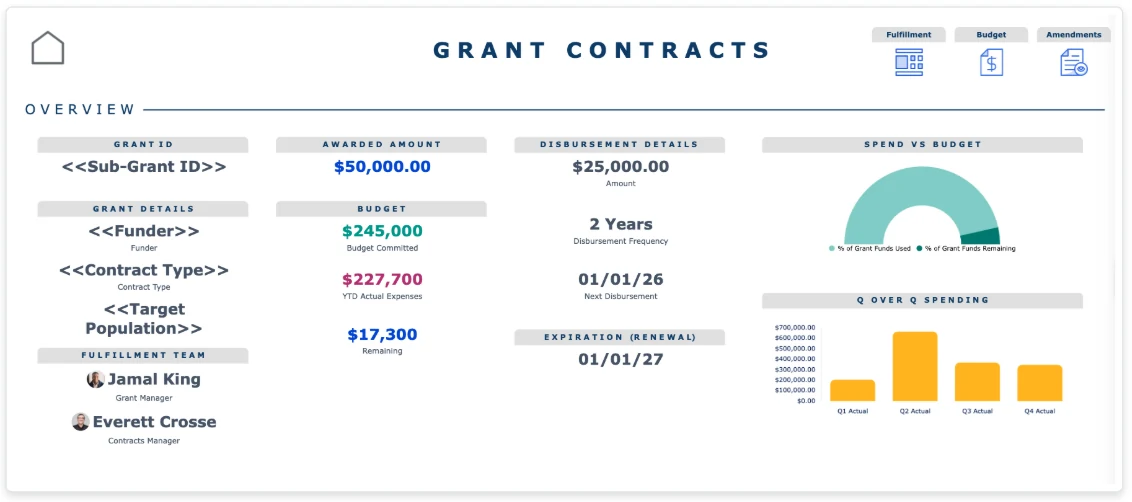
An individual workspace — the day-to-day system of record for one award. Schedule, budget, deliverables, disbursements, and the fulfillment team all live here, and this is where program staff actually work.
Groups grants that share a funding source or initiative. This is the tier that answers "how is this funder's money performing overall," which is usually the question that spreadsheets could never answer without a manual merge.
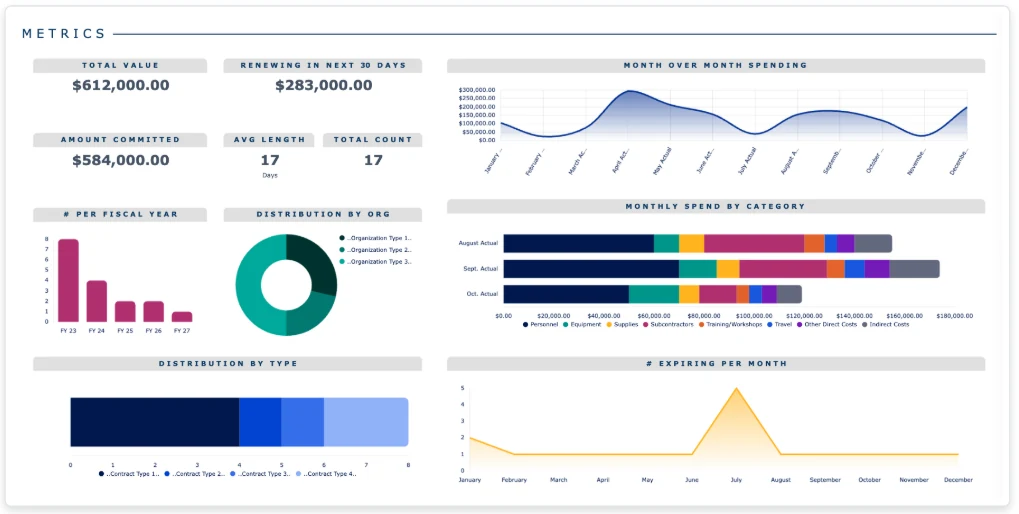
Executive rollup across every active grant. Spend trends, distribution, health status, and upcoming expirations in one view — assembled from live data rather than compiled from submissions.
Closed awards move out of the active portfolio without leaving the system. Historical grants stay queryable for audits and funder look-backs, but stop cluttering the dashboards leadership uses to run the current cycle.
Standardization is what makes the rollups possible. Every grant workspace gets provisioned with an identical structure, so portfolio reporting never has to reconcile four different ways of recording a budget line.
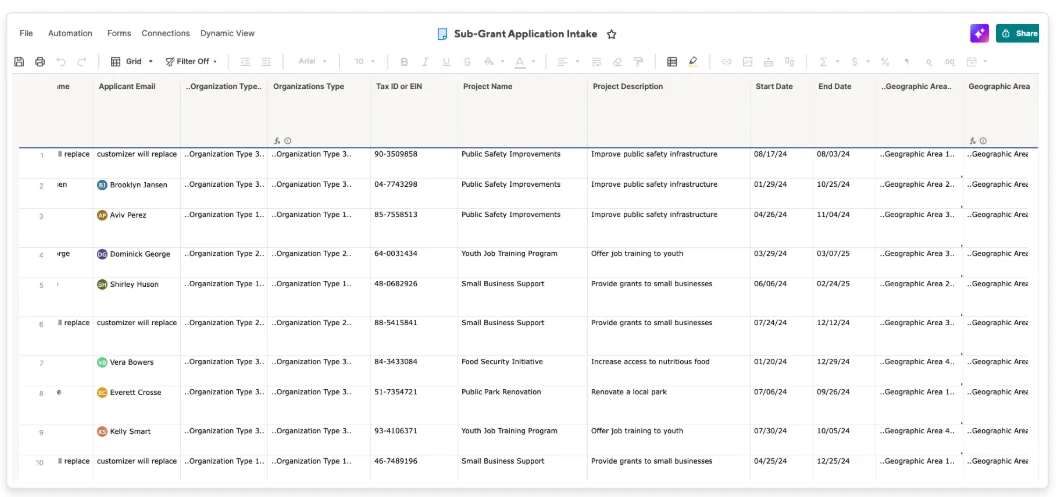
A consistent form captures award setup details the same way every time. External applicants submit through a public-facing form with save and resume, so a long application does not have to be completed in one sitting.
Every grant tracks progress against its own deliverables and dates. Deadline reminders and status alerts run on schedule rather than depending on someone remembering to check, which is where most compliance slippage originates.
Line-item budget versus actuals by category, tracked at the grant level and rolled up automatically. The portfolio spend figures leadership sees are the same numbers program staff maintain — there is no second version.
Status flows up to the portfolio rollup with no manual compilation. Funder and board reporting pulls from live data, which shortens the reporting cycle from a multi-day assembly job to a dashboard someone opens.
Most of the structure above is good practice. Two choices are what let the system scale past the point where a spreadsheet approach usually collapses.
The workspace structure gets built once as a blueprint, then provisioned many times over. A new grant spins up a complete, standardized workspace in minutes instead of being assembled by hand.
Because scoping is driven by the number of distinct blueprint types rather than the number of grants, running ten awards and running a thousand is the same build.
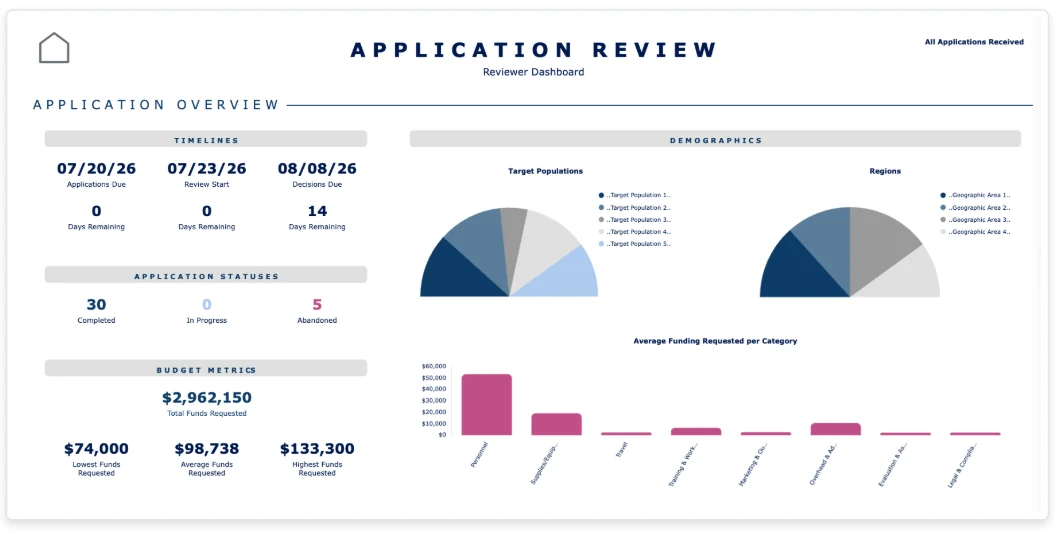
Applicants and reviewers get permissioned access to a single sheet, filtered by role, presented as a clean details panel rather than a grid. Reviewers can score; applicants cannot see the scoring.
External collaborators need no Smartsheet license — only the owning organization is licensed. For a grants program with hundreds of applicants, that is the difference between viable and unaffordable.
Portfolio, program, and grant were defined before any sheet was built. Every dashboard and rollup downstream inherits that hierarchy, so adding an award never triggers a reporting rebuild.
Teams that skip this step usually end up rebuilding their dashboards on the second or third funding cycle.
The portfolio kept growing. The reporting effort stopped growing with it — which was the whole point.
Leadership sees every award without navigating individual workspaces or asking program managers for status.
Funder and leadership reports pull from live rollups instead of manual compilation across scattered files.
Every new grant follows the same standardized workflow, so data stays comparable across the portfolio.
The system grows with the portfolio. Adding awards does not require rework of the reporting layer.
No. Applicants submit through a Smartsheet form, which requires no license or account. Reviewers and applicants who need ongoing access to their own records use Dynamic View, where only the owning organization holds licenses. This is usually the deciding cost factor for programs with a large applicant pool.
Core Smartsheet handles the intake, tracking, and reporting. Control Center adds blueprint-based provisioning, which matters once you are creating enough grant workspaces by hand that consistency starts slipping. Programs running a handful of awards a year often start without it and add it when volume justifies it — we will tell you honestly which side of that line you are on.
It depends on how many distinct grant types you run, not how many grants. Programs where every award follows one structure move considerably faster than programs juggling several fundamentally different funding mechanisms. A Discovery Workshop establishes which situation you are in before anyone commits to a scope.
Yes, and the reporting tiers usually map cleanly onto subrecipient structures. Public-sector programs typically add compliance requirements around audit trails, retention, and permission separation, which shape the build but do not change the underlying pattern.
That is common and it is handled with multiple blueprints rather than one. The scoping question is how many genuinely distinct structures exist — often fewer than teams assume, because differences that feel fundamental turn out to be field-level rather than structural.
Whether you are consolidating spreadsheets or scaling a portfolio that has outgrown its structure, we will map what you have and tell you honestly what we would build.
Pick a time that works. We will come prepared with questions about your funding cycles and reporting obligations.
Lifecycle tracking from application through close-out reporting, across state agencies, nonprofits, and higher education.